What Is Happening in Iran
An Explainer for Saturday Morning, February 28, 2026
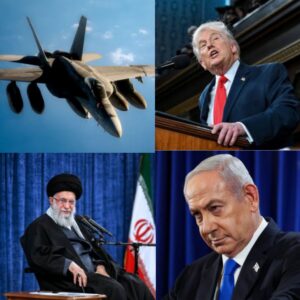
This morning the United States and Israel launched a large scale coordinated military operation against Iran. It is called Operation Epic Fury by the Pentagon and Operation Lion’s Roar by Israel. It began in the early morning hours while most Americans were asleep. By the time you are reading this, it has already escalated into an active exchange of strikes and retaliatory missile fire across the Middle East. Here is what you need to know.
What Happened
At approximately 2:30 am Eastern time, President Trump posted a video to Truth Social announcing that the United States had begun major combat operations in Iran. (Read the full statement in the comments). He was wearing a white USA cap at a podium in his Florida home. He did not address Congress before authorizing the strikes. He did not seek a declaration of war. He announced it on social media in the middle of the night.
The stated goals of the operation are to destroy Iran’s ballistic missile program, eliminate its nuclear development capability, and annihilate its navy. Trump also directly called on the Iranian people to overthrow their government when the strikes are over, telling them that the hour of their freedom is at hand and that this will probably be their only chance for generations.
That last element is significant. An American president directing a foreign population to rise up and replace their government during an active military operation is not standard military language. It is the language of regime change.
Israel’s strikes are running simultaneously under their own command structure and their Defense Minister has said the operation will continue as long as necessary. The Israeli military described it as a preemptive strike to remove existential threats to the state of Israel.
What Has Been Struck
Strikes have been reported across multiple Iranian cities, including Tehran, Isfahan, Qom, Tabriz, Kermanshah, Karaj, and Lorestan. In Tehran, explosions were reported near the offices of Supreme Leader Ayatollah Ali Khamenei, near the Islamic Revolutionary Guard Corps headquarters, and in several residential and commercial districts. Iranian media reported that a school in southern Iran was struck, with dozens of casualties reported though not independently confirmed.
Isfahan is significant because it houses a major Iranian nuclear facility. Qom and Fordow have also been reported as targets. The nuclear dimension of the strike appears to be a primary objective alongside degrading Iran’s missile architecture.
Khamenei’s whereabouts are currently unclear. Israeli officials confirmed he was targeted. Iranian state media has not confirmed his status. He is 86 years old.
Iran’s Response
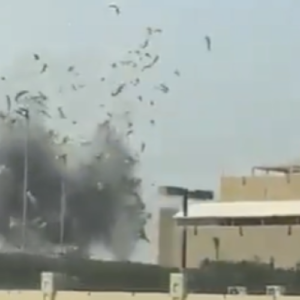
Iran retaliated quickly and broadly. The Islamic Revolutionary Guard Corps launched ballistic missiles at Israel and at US military installations across the Gulf region. The targets of Iranian retaliation include Al Udeid airbase in Qatar, which is the largest US military base in the Middle East; the US Fifth Fleet headquarters in Bahrain; Al Salem airbase in Kuwait; Al Dhafra airbase in the UAE; and US facilities in Jordan. Explosions were reported in Abu Dhabi and Dubai. One person has been killed in Abu Dhabi by shrapnel from an intercepted Iranian missile, which is the first confirmed fatality from Iranian retaliation as of this writing.
Qatar, the UAE, and Kuwait have closed their airspace. Iran has closed its airspace. Israel has closed its airspace. Airlines including Lufthansa, British Airways, and Virgin Atlantic have cancelled regional flights. International civilian aviation across the Middle East is in significant disruption.
The IRGC stated that all US and Israeli military targets in the Middle East are legitimate targets and that the operation will continue relentlessly until the enemy is decisively defeated. Iranian backed militias in Iraq have also threatened to begin attacking US bases. Two fighters from an Iraqi militia were killed earlier in the day in airstrikes attributed to the US or Israel.
As of this writing, there are no confirmed American military casualties. Trump acknowledged in his announcement that casualties are possible and called it a noble mission.
The Background You Need
This did not come from nowhere. In June 2025, the US and Israel conducted what Trump called Operation Midnight Hammer, a 12 day air campaign against Iranian nuclear facilities at Fordow, Natanz, and Isfahan. Trump claimed at the time that Iran’s nuclear program had been obliterated. Iran denied this and continued its nuclear activities. We were told by Tucker Carlson this would create World War 3. It did not. That message is being repeated now.
Since December 2025, Iran has been wracked by nationwide anti-regime protests triggered by economic collapse, the fall of the rial, and rising prices. Trump stated at a press briefing on Friday that the Iranian regime had killed approximately 32,000 protesters, a figure consistent with estimates from Iranian health ministry sources. The protests are described as the largest in scale since the 1979 revolution.
In the weeks leading up to today, the US assembled its largest military deployment to the Middle East since the Iraq War, including carrier groups, fighter jets, and additional warships. Negotiations between the US and Iran were ongoing in Geneva as recently as Thursday. The Omani foreign minister, who helped mediate those talks, told CBS News on Friday that he was confident a peace deal was within reach and that Iran had agreed to zero stockpiling of enriched uranium. Trump said on Friday he had not yet decided whether to attack.
Then he attacked.
A senior Middle East diplomat with direct knowledge of the talks told multiple news outlets that negotiations were close to success when Israel intervened. The diplomat said: “yet again when negotiations get close to success Israel has intervened.”
It is a fact that diplomats will blame Israel (and are as you can see in NBC coverage).
It is also important to recognize that the diplomats who are either failures or something worse said that Iran had stopped working on nukes repeatedly when they had not. The stench coming from Foggy Bottoms of failure from diplomats who bought Iranian lies now for decades should be recognized.
Israel Can Fight Differently Today Than It Could Five Years Ago
Most coverage of Israel’s role in this operation focuses on what Israel is doing right now. The more important story is what Israel spent the last several years doing to make this moment possible.
October 7, 2023 was not simply a Hamas attack. It was an Iranian operation. Hamas could not have planned, equipped, or executed that assault without Iranian money, Iranian weapons, Iranian training, and Iranian strategic direction. The same is true of Hezbollah, which has been firing rockets into northern Israel from Lebanese territory intermittently for decades, and which has killed Christians in Lebanon and destabilized that country for longer than most Americans have been paying attention. These were not independent terror organizations that happened to share Iran’s enemies. They were Iran’s forward deployed military capacity, positioned on Israel’s borders so that any direct confrontation with Tehran would immediately trigger a multi front war against Israel’s civilian population.
That was the trap. For years, Iran’s strategic genius was that it had essentially ringed Israel with its own military force while keeping its own territory untouched. Any Israeli or American action against Iran would activate that ring. The price of striking Iran was a simultaneous war on multiple borders, with rockets falling on Israeli cities from Lebanon in the north and Gaza in the south, with Hezbollah’s precision missile stockpiles capable of reaching every major Israeli population center, and with the possibility of additional fronts opening through Iranian proxies in Syria, Iraq, and Yemen.
Five years ago, that calculus was real and it constrained everyone’s options. Today it is not the same calculus.
Israel spent the period since October 7 methodically dismantling the infrastructure Iran had spent decades and billions of dollars building. Hamas has been functionally destroyed as a military organization in Gaza. Its leadership is dead. Its tunnel networks are destroyed. Its ability to conduct large scale coordinated operations is gone. Hezbollah, which was the more dangerous of the two organizations by a significant margin, has been hit harder than at any point since its founding. Its senior leadership, including Hassan Nasrallah, was killed. Its precision missile stockpiles, which represented the real strategic threat to Israeli cities, have been substantially degraded. Its ability to conduct the kind of sustained multi-front pressure that would have made a direct confrontation with Iran catastrophic for Israeli civilians has been dramatically reduced.
What Iran activated in October 2023, intending to tie Israel’s hands, Israel used as the justification and the opportunity to clear the board. The attack that was supposed to prevent Israel from ever being able to join a strike on Iran instead produced the conditions that make Israel’s participation today far less costly than it would have been.
This does not mean Israel faces no threat from Iran’s retaliation.
Missiles are falling on Israel as you read this and the Iron Dome and David’s Sling systems are working to intercept them. But the threat Israel faces today from Iranian proxies is a fraction of what it was before October 7. The multi front war that Iran had positioned to deter exactly this kind of operation has already been largely fought, and Israel largely won it.
Iran spent forty years and enormous resources building a terror network designed to make itself untouchable. That network is now substantially dismantled. The deterrent failed. And Israel, which absorbed the cost of fighting through it, is now free to participate in the operation Iran’s network was built to prevent.
That is the strategic context the headlines are not giving you.
The Kurdish Dimension: The Strategic Asset No One Is Talking About
There are early reports that the United States may partner with Kurdish forces as part of this operation. If that is true, it is one of the most strategically sound decisions the US could make, and it requires some background to understand why.
The Kurds are the largest nation on earth without a recognized state. Approximately 30 to 40 million Kurds are spread across Turkey, Iraq, Syria, and Iran, with no country of their own, surrounded on all sides by governments that have historically treated them as a threat to be managed or destroyed. Saddam Hussein used chemical weapons on Kurdish civilians. Turkey has fought a decades long war against Kurdish political organizations. The Syrian government has suppressed them. Iran has done the same.
Despite all of that, the Kurds have remained one of America’s most reliable partners in the region, and the loyalty runs in both directions. It goes back to the aftermath of the Gulf War, when the United States established a no fly zone over northern Iraq and provided air cover that stopped Saddam’s military from finishing what his chemical weapons had started. The Kurds remember that. They remember it in a way that very few people in the Middle East remember American interventions, because most American interventions in the region have made things worse for the people living there. The Kurdish experience is different. American air power saved their villages.
When ISIS emerged and swept across Iraq and Syria, it was Kurdish forces, primarily the Syrian Kurdish YPG and the Iraqi Kurdish Peshmerga, who did the grinding ground combat that broke the Islamic State’s territorial caliphate. American airpower provided the umbrella. Kurdish fighters provided the boots. They bled for it. Thousands of them died. They defeated ISIS not as a favor to America but because ISIS was an existential threat to them, which made the alliance genuine rather than transactional.
The Kurds are also a pluralistic people in a region that is not. They are predominantly Muslim, with both Sunni and Shia communities, but they also have significant Yazidi and Christian minorities. They have a track record of tolerating religious difference that is unusual in the neighborhood. Critically, they define themselves as Kurds first, before any religious identity. That is the opposite of the dynamic that has made so many other US partnerships in the region fail.
Consider the comparison to Christian Arabs in southern Lebanon. People who identified as Christian Arabs proved, when it mattered, that Arab identity took precedence over Christian identity. They accepted weapons and support from the United States and Israel and then, when the pressure came, they turned those weapons over to the enemy and allowed terrorist infrastructure to operate from their villages. The identity hierarchy produced a catastrophic partnership failure. When your allies define themselves primarily by an identity they share with your enemy, you cannot fully trust them.
The Kurds do not have that problem. They are surrounded by enemies on all sides: Iran, Turkey, the Arab states of Iraq, and Syria. Their enemies are America’s enemies. Their interests align with American interests not because of sentiment but because geography and history have made it so. That is the most durable kind of alliance.
Here is why this matters specifically in the Iranian context. Iran has a large Kurdish population, estimated at somewhere between eight and twelve million people, concentrated in the western provinces. Those Kurds have been suppressed by the Islamic Republic for decades. They have their own grievances against the IRGC. If the United States establishes air dominance over Iran, which its military capability makes achievable, Kurdish forces with motivation, local knowledge, and existing military organization can do what the United States has historically been least effective at: sustained ground operations in complex terrain against irregular forces.
The strategic logic is straightforward. When American airpower has turned the IRGC’s armored assets into wreckage, the ground phase becomes a consolidation operation rather than a war of maneuver. That consolidation still requires people willing to take the danger of close combat, willing to manage supply lines through difficult country, willing to hold territory and absorb the human cost of doing it. American political will for that kind of casualty generating ground operation is limited. Kurdish will to fight the IRGC, the force that has been suppressing them for forty years, is not limited.
In exchange for that partnership, the United States can offer something the Kurds have wanted for a century: recognition, territory, and a future. What emerges from this conflict, if it goes well, could be an Iran that transitions away from theocratic rule toward something that honors the genuine greatness of Persian civilization without exporting death across the region. The Islamic Republic is not Persia. It is a death cult that hijacked one of the world’s great ancient civilizations. The Persian people deserve better than it. The Kurds, who have also been denied their own civilization’s recognition, deserve a partner who keeps its commitments.
Whether the United States will make and keep those commitments is the honest question. We have a complicated record with the Kurds. In 1991 we encouraged them to rise up against Saddam and then left them to be slaughtered when it became strategically inconvenient. In 2019, the Trump administration abruptly withdrew support for Kurdish forces in Syria, exposing them to Turkish attack. The Kurds have reason to be cautious about American promises. If this partnership is real, it needs to be backed by something more durable than the next news cycle.
The Constitutional Question
Trump did not seek authorization from Congress before launching these strikes. The Constitution assigns the power to declare war to Congress, not the President. The War Powers Resolution of 1973 requires the President to notify Congress within 48 hours of committing forces to hostilities and prohibits forces from remaining in conflict for more than 60 days without congressional authorization.
Democratic Senator Tim Kaine called the strikes dangerous, unnecessary, and idiotic and called for the Senate to immediately return to session and vote on a War Powers Resolution to block the use of US forces against Iran. Republican lawmakers have been largely silent as of this morning, though some had previously asked Trump publicly why he had not addressed Congress or the American people before acting.
Trump has political exposure here beyond the legal question. He built his political brand in part on opposing foreign military adventurism. His base does not have a strong appetite for American casualties in Middle Eastern wars. He acknowledged in his announcement that American lives may be lost. That is a politically significant admission.
What to Watch
The next 24 to 72 hours will determine whether this is a contained operation or the beginning of a sustained regional war. The key variables are these.
First, whether Iran’s retaliation causes significant American casualties. Trump has framed this as a noble mission with acceptable risks. American deaths would change the political dynamic at home immediately and dramatically.
Second, whether Hezbollah in Lebanon and Hamas in Gaza have enough remaining capacity to meaningfully enter the conflict. Both organizations have been severely degraded, but neither is fully destroyed, and Iran will attempt to activate whatever remains.
Third, whether the Houthi movement in Yemen resumes attacks on Red Sea shipping. The Houthis have signaled they will support Iran. A return to Red Sea disruption would affect global trade and energy markets.
Fourth, what happens inside Iran. The combination of ongoing anti-regime protests, economic collapse, and now a large-scale external military attack creates a volatile internal situation. Trump is explicitly calling for the population to take over their government. Whether that message accelerates the regime’s collapse or rallies Iranians around the flag is genuinely uncertain.
Fifth, the fate of Khamenei. If the Supreme Leader has been killed or seriously incapacitated, the succession question in Iran becomes immediate and unpredictable.
Sixth, whether the Kurdish partnership materializes into something real and sustained. That variable may ultimately determine whether this operation produces a durable strategic outcome or another Middle Eastern intervention that costs blood and treasure and leaves the region no better than it found it.
A Word to People Asking What Iran Ever Did to Us
I have seen this question asked repeatedly this morning, sometimes out of genuine ignorance and sometimes with an agenda behind it. It deserves a direct answer.
In November 1979, Iranian students loyal to Ayatollah Khomeini stormed the United States Embassy in Tehran and held 52 American diplomats hostage for 444 days. This was not a spontaneous protest. The Iranian government endorsed it, supported it, and used it as a founding act of the Islamic Republic’s identity. Taking the official diplomatic staff of another country hostage is an act of war under any serious reading of international law. Iran has never apologized for it and has celebrated it annually every November since.
Since then, Iran has been directly or indirectly responsible for the deaths of hundreds of Americans. The 1983 bombing of the US Marine barracks in Beirut, which killed 241 American servicemen, was carried out by Hezbollah with Iranian backing. Iran was the primary sponsor of Shia militias in Iraq that used Iranian supplied explosively formed penetrators to kill American soldiers throughout the Iraq War. The US military has attributed hundreds of American deaths in Iraq specifically to Iranian supplied weapons and Iranian-trained fighters.
Iran has attempted to assassinate American officials on American soil. It has placed bounties on American citizens. It has financed, armed, and directed organizations whose explicit mission includes killing Americans and destroying the United States as a political order. Before Trump returned to office, Iranian government organized crowds gathered annually to chant Death to America and Death to Israel as official state policy. This is not a fringe sentiment tolerated by the government. It is a government program.
Iran’s failure to kill as many Americans as al-Qaeda did on September 11th is not evidence that Iran is not a threat. It is evidence that their attempts have been less successful, not less numerous and not less intentional.
As for the question of why “Death to America” and not “Death to Canada” is chanted. There is a reason the crowds in Tehran do not chant Death to Canada. It is because of the unique space our nation occupies. Since before I was born, we are the only liberating force that threatens their control. People correctly point out that some of the hatred of America come from our intervention to depose the Prime Minister and strengthen the rule of the shah in the 1950s, but that was mostly to protect British oil interests, and the British were more deeply involved than the CIA.
So why are we the focus of their hatred? It is because the Islamic Republic’s foundational ideology frames America as the Great Satan, the primary symbol of the liberal world order it seeks to destroy, and Israel as the Little Satan, its forward presence in the Muslim world. This is not a geopolitical disagreement. It is a theological one. The Islamic Republic does not want a better relationship with America. It wants America’s civilization to end. You do not negotiate that away. You either defeat it or you wait for it to defeat you.
The young Iranians who have been shot in the streets over the last several months asked specifically for American help. Not Canadian help. Not German help. Not UN mediation. American help, because America is the country that the rest of the world still looks to when they want someone to actually do something. That is a burden and a responsibility and sometimes a curse. It is also who we are.
What This Is and What It Is Not
I want to be clear about something before I close, because I am seeing the Afghanistan and Iraq comparisons already and they need to be addressed.
I am deeply opposed to the model of liberation and occupation that the United States attempted in Afghanistan and Iraq. We went in, we toppled the governments, we tried to rebuild nations from the outside, we stayed for decades, we spent trillions of dollars, we lost thousands of American lives, and we left both countries worse than we found them or roughly the same. That model failed. It failed in Vietnam before that. It is not a model we should repeat.
What appears to be happening in Iran is materially different.
This looks far more like what Bill Clinton authorized in the Balkans in the 1990s than what George W. Bush authorized in Iraq in 2003. Clinton used American airpower to degrade Serbian military capability, provided air cover and logistical support to ground forces with their own motivation to fight, and did not send American ground troops to occupy and govern. The outcome was imperfect. The region is still complicated. But the intervention stopped a genocide, it did not create a decades long occupation, and it did not cost thousands of American ground troops their lives.
The model here, if executed as it appears to be designed, is airpower plus support for indigenous forces with their own reasons to fight, not American boots governing Iranian cities. The Kurds are not a puppet government we are installing. They are a people with their own history, their own grievances, and their own reasons to fight the IRGC that predate any American involvement by decades.
That is a meaningfully different thing from what we did in Baghdad in 2003. Whether the execution lives up to the design is the question the next weeks and months will answer. But the people drawing a straight line from Iraq to Iran are not reading the situation accurately.
What I Think
I am not a foreign policy analyst. But I can read, and here is what the record shows.
Iran has been a genuinely dangerous actor. Its nuclear ambitions are real. Its support for groups that kill Americans and Israelis is documented. The Iranian regime has murdered tens of thousands of its own people in the last two months alone. The Islamic Republic has been the largest state funder of terrorism on earth for four decades. I do not mourn it.
But the sequence of events here is worth sitting with. Negotiations were reportedly close to a deal as recently as Thursday. The US had assembled an enormous military force in the region while those negotiations were happening. By Friday night Trump said he had not decided. By Saturday morning bombs were falling on Tehran.
The decision to go to war (or what will be called a war by the vast majority of people) without congressional authorization, announced on social media at 2:30 in the morning, during Ramadan, the day before Purim, while diplomatic talks were still technically active, is not a decision that will be fully understood for years. The consequences, military, political, economic, and humanitarian, are unfolding right now and no one can tell you with confidence how they end.
What I can say is this: if the goal is a Middle East where Iran is no longer a death cult exporting terror, where the Persian people have a future worth having, and where the Kurds finally have a partner who honors its commitments, those are goals worth pursuing. The question is whether the execution matches the vision. That answer is still being written.
Pray for the Americans in harm’s way. Pray for the Iranian civilians who did not choose this government and who are now living under bombs. Pray for the Kurds, who have been waiting for a century for the world to keep its word to them. And pay attention, because what happens in the next few days will matter for a long timeotnan