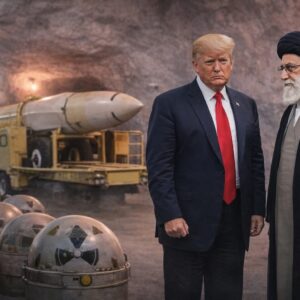
Iran is often underestimated by many observers in the United States, yet a closer look at the country’s structure, geography, and long-term strategy reveals that it possesses far more resilience and strength than is commonly assumed. Several key factors help explain why Iran has developed a reputation among regional analysts as a state that is difficult to pressure or destabilize quickly.
First, Iran’s military power is not limited to a single traditional army that could be easily targeted or disabled. While it does maintain regular armed forces, a large portion of its defense capability lies within the Islamic Revolutionary Guard Corps (IRGC) and various paramilitary organizations connected to it. These groups operate across different parts of the country and are deeply integrated into Iran’s security system. Their structure is decentralized and layered, meaning that even if some facilities or units were weakened, many others would continue functioning. This distribution of forces makes it extremely difficult for any opponent to neutralize Iran’s military capacity with one decisive strike or a short campaign.
Second, Iran’s political system is built in a way that spreads authority across several institutions rather than concentrating it in a single leader or office. While the president plays an important administrative role, ultimate authority lies with the Supreme Leader, who works alongside other powerful bodies such as the National Security Council, the parliament, and various advisory institutions. Because power is divided and interconnected, the system is less vulnerable to sudden political shocks. If one part of the leadership structure faces pressure or instability, other institutions can continue to function, allowing the overall political system to remain intact.
Third, Iran’s geographic position gives it major strategic importance. The country sits near one of the world’s most critical maritime chokepoints: the Strait of Hormuz. A significant percentage of global oil shipments travel through this narrow waterway every day. Because Iran has influence over this region and possesses the capability to disrupt shipping if a conflict were to occur, any military confrontation there could quickly affect global energy markets. This creates a powerful deterrent, since disruption in that area could lead to economic consequences far beyond the Middle East.
Fourth, Iran has spent decades building a network of regional relationships and partnerships that extend beyond its own borders. Through political ties, security cooperation, and alliances with various groups and governments in the Middle East, Iran has created a system of influence that complicates any potential conflict. A confrontation with Iran would not necessarily remain limited to its territory, because regional partners could become involved in different ways. This interconnected network increases the strategic complexity of dealing with Iran and raises the risks of escalation.
Fifth, Iran’s society and political leadership share a strong sense of ideological commitment and national identity. Over the years, many Iranians have developed a mindset shaped by historical struggles, revolution, and external pressure. This has produced a population that, in many cases, views resistance and independence as central national values. Such ideological and nationalist resilience can make a country more capable of enduring hardships, including political isolation or economic pressure from abroad.
Sixth, Iran has invested heavily in missile technology and other military innovations. Its ballistic missile program is considered one of the most developed in the region, providing the ability to strike strategic targets at significant distances. These capabilities serve both as a defensive shield and as a deterrent, since potential adversaries must consider the possibility of retaliation against military bases, infrastructure, or other strategic locations.
Finally, Iran has spent more than four decades operating under various international sanctions and economic restrictions. Rather than collapsing under that pressure, the country gradually adapted by developing alternative economic mechanisms, domestic industries, and regional trade partnerships. This long experience with sanctions has helped Iran build systems designed to function even under difficult external conditions. As a result, the Iranian state has become accustomed to operating in an environment of pressure, which adds another layer of resilience to its political and economic structure.
Taken together, these factors help explain why Iran is often described as more complex and more durable than many outside observers initially assume. Its decentralized military structure, layered political system, strategic geography, regional connections, ideological cohesion, technological investments, and long experience with sanctions all contribute to a country that is far more difficult to confront or weaken quickly than simple analyses sometimes suggest.